
Full Audit: Walmart
(Not Including Leadership)


Walmart Brand Evaluation Narrative (2019–2025)
Summary
Walmart maintains its position as a dominant player in retail with a clear operational focus on affordability and convenience, but it falls short on emotional resonance, cultural depth, and distinctive innovation. While its adaptability and scale are commendable, the brand lacks a unique and inspiring vision, and its messaging remains generic compared to more purpose-driven competitors. Walmart’s operational excellence does not fully translate into a differentiated customer proposition or a compelling narrative, and its reputation is vulnerable to criticism over ethics and cultural misalignment.
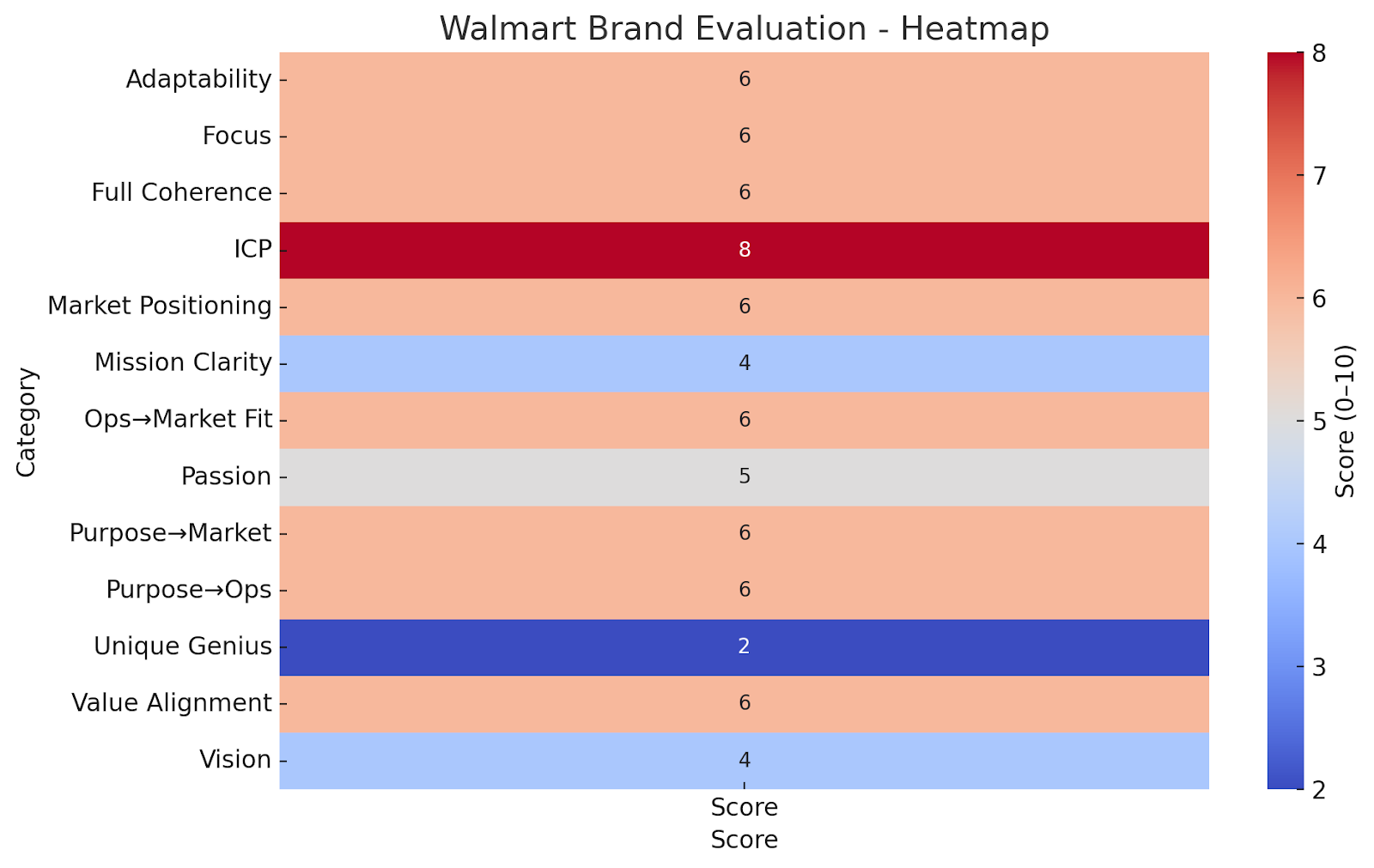
Scores and Justifications
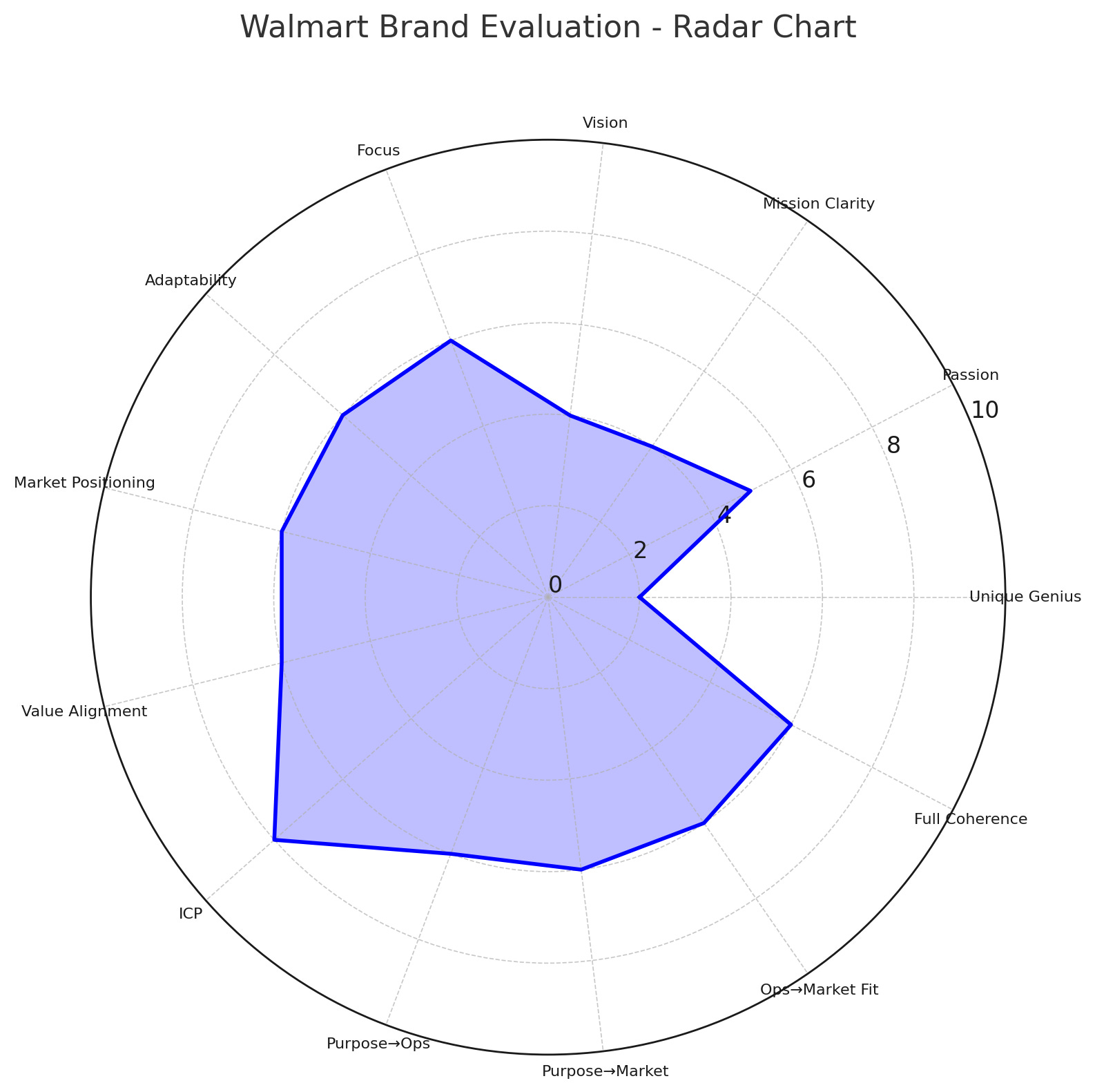
Narrative by Variable
Brand Purpose: Unique Genius — Score: 2
Walmart’s claim of offering low prices and wide selection is not distinctive in today’s retail landscape. Competitors like Target, Amazon, and regional players use similar language, diluting the uniqueness of this promise. This weak articulation of a truly unique “genius” creates vulnerability: customers have little reason to emotionally prefer Walmart beyond price.
Recommendation: Articulate a more differentiated capability — for example, Walmart’s unmatched scale in local communities, or its logistical excellence as a “hidden hero” behind affordability — and integrate that into messaging.
Cultural Alignment — Score: 4
Walmart shows some alignment to cultural trends, including sustainability initiatives and community outreach. However, these feel reactive or partial, as critiques about labor practices and environmental impact overshadow the positive. Cultural alignment is neither central nor consistent to the brand identity yet.
Recommendation: Embed cultural initiatives more deeply into operations, messaging, and customer experiences — and address critiques head-on in transparent, authentic ways.
Brand Purpose: Passion — Score: 5
There is evidence of passion in internal messaging around affordability, convenience, and community, but it lacks intensity and external validation. Customers and third-party observers rarely describe Walmart as a “passionate” brand.
Recommendation: Elevate leadership storytelling to convey more heart and pride in the mission of enabling better lives for customers. Show the human impact of affordability beyond price tags.
Vision — Score: 4
Walmart’s vision — to offer low prices and good service — is clear but uninspiring. While it is credible and achievable, it doesn’t excite stakeholders or stand out among peers.
Recommendation: Evolve the vision to reflect Walmart’s broader impact and leadership ambition — for example, as a force for resilience and fairness in retail communities.
Focus — Score: 6
Walmart maintains consistent focus on operational efficiency and customer convenience. This is a strength, but its messaging and strategic actions still lack a feeling of breakthrough discipline or pioneering clarity.
Recommendation: Reinforce Walmart’s singular focus more boldly — and back it up with metrics and stories of measurable customer value.
Adaptability — Score: 6
Walmart earns credit for evolving — notably in e-commerce, supply chain technology, and responsiveness to consumer preferences. Forbes and Harvard Business Review cite Walmart’s agility, showing it can learn and pivot effectively.
Recommendation: Publicize adaptability stories more proactively to strengthen its reputation as a forward-thinking brand.
Positioning — Score: 6
Walmart’s positioning — affordability and convenience — is clear and strong but lacks distinctiveness. Competitors use similar claims. The lack of third-party recognition limits credibility.
Recommendation: Introduce more unique dimensions to the positioning, such as superior community presence, reliability in tough times, or local economic impact.
Value Alignment — Score: 6
Walmart delivers affordability but struggles with customer service, product quality, and ethical perceptions. Trustpilot reviews cite frustration with service and practices.
Recommendation: Address customer service pain points and communicate improvements transparently to close the gap between values and experience.
Ideal Customer Profile (ICP) — Score: 8
This is one of Walmart’s strongest areas. It effectively identifies and serves its ICP — value-conscious, convenience-driven shoppers — and garners praise from third-party publications.
Recommendation: Double down on ICP excellence while exploring opportunities to expand or refine secondary customer segments.
Purpose → Operations — Score: 6
Walmart’s purpose informs operations, especially supply chain and pricing strategy. However, there’s no standout recognition of purpose inspiring operational innovation.
Recommendation: Make the connection between purpose and operations more explicit — for example, how sustainability and affordability co-exist.
Purpose → Market — Score: 6
Messaging reflects Walmart’s purpose of affordability but misses emotional resonance. Customers see the low prices but don’t necessarily feel the deeper meaning behind them.
Recommendation: Inject more emotional storytelling and customer success stories into market-facing messaging.
Operations → Market Fit — Score: 6
Walmart’s operational excellence supports market fit, but without standout recognition as an innovator or industry leader in customer proposition.
Recommendation: Highlight how operational strengths create tangible customer benefits to elevate perception.
Full Coherence — Score: 6
Overall, Walmart achieves functional alignment between purpose, operations, and market fit. Yet gaps remain: cultural misalignments, lack of distinctiveness, and muted passion dilute the impact.
Recommendation: Strengthen the coherence narrative — demonstrate how Walmart’s purpose drives every decision and creates competitive advantage.
Summary
Walmart scores mid-level on most variables, showing reliable but uninspired performance. Its ICP targeting and adaptability are notable strengths, while its weak articulation of unique genius and modest cultural alignment hold it back.
Opportunities:
Elevate emotional storytelling and leadership passion.
Differentiate positioning beyond price and convenience.
Improve cultural alignment and service experience to deepen trust.
Make the connection between operational excellence and customer value more visible.
Strengths
Operational excellence and supply chain efficiency.
Clear value proposition of affordability and convenience.
Strong product-market fit for mass-market customers.
Adaptable and disciplined in execution.
Gaps
Vision and messaging are uninspired and generic.
Emotional resonance and cultural alignment are weak.
Innovation and differentiation are minimal.
Trust and reputation weakened by ethical criticisms.
Recommendations
Articulate a bolder, more differentiated vision tied to cultural trends (e.g., sustainability, equity).
Build emotional resonance into brand storytelling beyond price and convenience.
Enhance innovation narrative and communicate technology advancements more compellingly.
Strengthen trust through transparency and proactive initiatives addressing criticisms.
Walmart Brand Evaluation: Expanded Narrative
Authenticity & Language Profile
Walmart shows moderate authenticity in its messaging. The language remains rooted in its core value of affordability but lacks emotional authenticity or customer-centric storytelling. Words like authentic or phrases conveying authentic care are rare in external reviews or campaigns.
Authenticity/Authentic in Use: Score: 3/10 — present but perfunctory, often reduced to marketing slogans rather than lived experience.
Messaging could benefit from customer stories, transparent acknowledgment of challenges, and leadership voices that connect personally with the mission.
Mindset Indicators
Walmart exhibits a balanced but muted psychological profile, suggesting operational stability but little differentiation or emotional leadership:
Opportunity: 2 — very low. Little evidence of bold risk-taking or market-creating behavior.
Disciplined: 3 — better, with operational rigor and procedural consistency evident.
Results: 2 — results are stable, but customer-facing language does not signal ambition or measurable wins clearly.
Systematic: 3 — supply chain excellence and operational frameworks are clear, but the systematic mindset is inward-facing and not well-articulated publicly.
Narcissistic/Obstructionist: 3/3 — moderate signs of defensiveness in the face of critiques and little evidence of self-critical cultural maturity.
This mindset profile suggests a focus on maintenance over leadership — a pattern typical of incumbents at scale who have lost some entrepreneurial hunger.
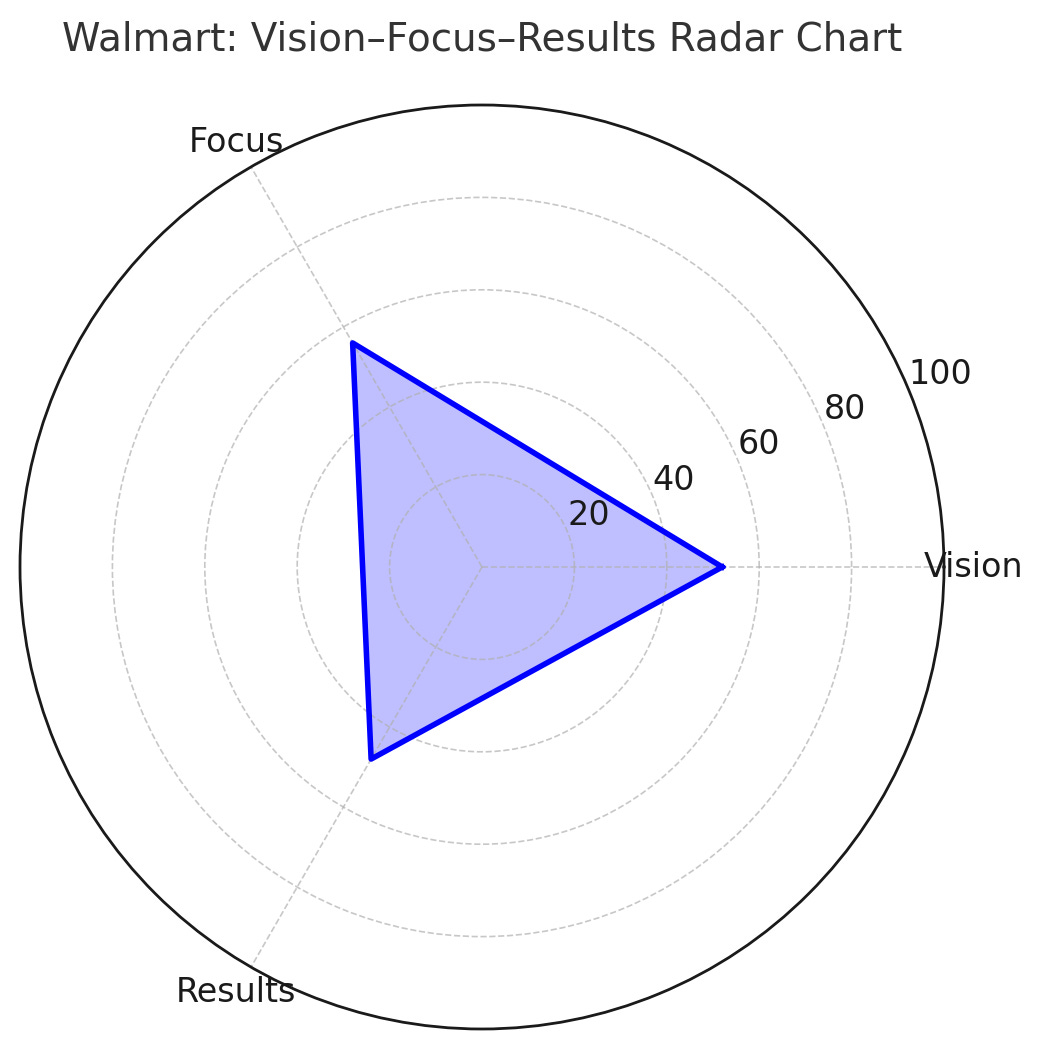
Vision: 52%
Focus: 56%
Results: 48%
Vision Analysis
Findings
1. Strategic Intent
Score: 3 — Walmart’s intent (“Save money, live better”) is clear but undifferentiated and uninspiring compared to visionary competitors.
2. Innovation Narrative
Score: 2 — There are scattered mentions of AI and sustainability, but not positioned as central to the story.
3. Leadership Framing
Score: 3 — Leaders echo the mission but rarely frame an inspiring, future-facing vision.
4. Market Hypothesis
Score: 2 — Few public statements reflect insight into how customers or markets will evolve in the next 5–10 years.
5. Differentiation
Score: 3 — Affordability is not enough to clearly differentiate; there is little articulation of a unique competitive edge.
Summary: Walmart’s vision remains operationally viable but uninspired and backward-looking. It does not demonstrate the strategic foresight or narrative boldness expected of a market leader.
Focus Analysis
Findings
6. Opportunity Selection
Score: 3 — Walmart continues to target price-conscious, convenience-driven customers effectively but without refining its focus to higher-value segments.
7. Execution Modality
Score: 3 — Primarily builds in-house, with occasional partnerships, but lacks a clear pattern or innovative approach.
8. Tech–Problem Alignment
Score: 3 — Technology investments are substantial but do not clearly map to stated customer problems.
9. Technology Readiness
Score: 2 — While pilot programs exist, there is no clear communication of maturity or deployment stages.
10. Strategic Repetition
Score: 2 — Tends to repeat legacy strategies rather than updating playbooks for new market realities.
Summary: Walmart’s focus remains adequate for incremental improvement but shows little evidence of strategic renewal or sharp execution in emerging areas.
Results Analysis
Findings
11. Customer Momentum
Score: 3 — Walmart retains a massive base but does not showcase growth or retention as a competitive advantage.
12. Value Capture
Score: 2 — Pricing remains blunt, with few innovations in how value is captured or delivered.
13. Talent Velocity
Score: 2 — There is no clear communication about strategic hiring or leadership aligned with innovation.
14. Product/Market Expansion
Score: 3 — Expansion into new offerings (e.g., e-commerce) is visible but not strategically differentiated.
15. Innovation ROI
Score: 2 — Investments in innovation have yet to deliver clear, measurable business outcomes.
Summary: Walmart’s results reflect steady incumbency rather than breakout momentum, with room to improve in talent signaling, product innovation, and value innovation.
Cumulative Insights
Strengths: Operational discipline, scale, and functional ICP alignment remain Walmart’s anchors.
Weaknesses: Visionary storytelling, cultural alignment, and differentiated innovation are weak points that could erode long-term relevance.
Opportunities: Walmart could leverage its size and supply chain to lead culturally-relevant retail transformation (e.g., inclusive commerce, sustainable sourcing, hyper-local innovation).
Walmart Brand Trust & Peak A+ Analysis
This analysis builds on earlier findings by evaluating Walmart’s customer, employee, ecosystem, and values signals, with a focus on “Peak A+” readiness and key organizational values. Each section includes qualitative insights based on the provided scores.
Want these deeper insights? Become a paid subscriber.
Keep reading with a 7-day free trial
Subscribe to Stealth Dog Insights to keep reading this post and get 7 days of free access to the full post archives.